Can I use ordinary table salt instead of rock salt?
You can, but it will not work as well. Ice alone sits at freezing point, which is not cold enough to freeze a cream mixture in reasonable time. Adding salt turns the melting ice into a brine that stays liquid well below freezing, drawing heat out of the canister far faster. Rock salt or coarse ice cream salt is what you want, because the large crystals dissolve steadily through the melting ice; fine table salt dissolves too quickly at the top and gives an uneven, short-lived freeze. Layer them, ice then a scatter of salt then more ice, rather than tipping salt on top all at once.
Why did my batch take 45 minutes when the box says 20?
Several things outside the machine decide the actual time. The starting temperature of the mixture matters most: a base chilled thoroughly in the fridge freezes far faster than one mixed at room temperature. How well the ice and salt are packed matters next, since a loose fill with gaps surrounds the canister with air rather than brine. A warm kitchen and a full canister slow things down too. Treat 20 minutes as the best case with a well-chilled base and a well-packed bucket, and 30 to 45 minutes as normal in most kitchens.
Why is my ice cream soft rather than scoopable like shop ice cream?
That is exactly what this kind of machine is meant to produce: soft-serve consistency straight from the canister, which is genuinely good eaten that way. If you want a firmer, scoopable texture, move it to a container and put it in the freezer for a few hours, a step called ripening, which also lets the flavours settle. Shop ice cream is frozen much harder before it reaches you, which a home churn does not replicate directly.
What size batch should I actually make?
Four quarts is party quantity, considerably more than a household of two will get through before it starts developing ice crystals in the freezer, since homemade ice cream has no stabilisers or preservatives to extend its life. For a small household, make a smaller batch, which also goes easier on the motor, or plan to share it. Owners who make ice cream for friends and neighbours are among the happiest with the full capacity.
How do I keep the bucket in good shape?
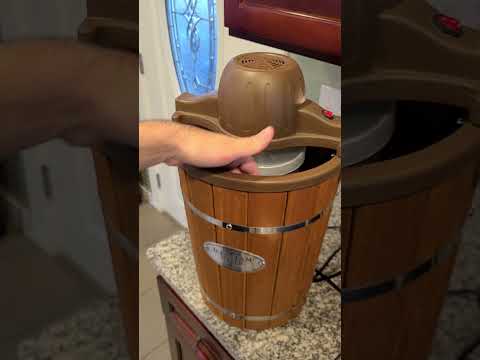
Rinse it thoroughly after every use and let it dry completely before storing it. The bucket holds salt brine while churning, and salt left to dry on it builds up and can mark it over time. The wood look is a big part of its charm, and a bucket that goes away clean and dry is the simplest way to keep it looking that way from one summer to the next.
Do I need to buy anything else to use it?
Yes: ice and rock salt for every batch. Nostalgia's instructions are to layer ice and salt around the canister, so this is not a frozen-bowl machine and there is no pre-freezing step, but there is an ongoing cost per batch. Buy a large bag of ice and a box of rock salt or coarse ice cream salt along with the machine so you are not caught out on the first use, and consider one of Nostalgia's ice cream kits if you want an easy first batch.