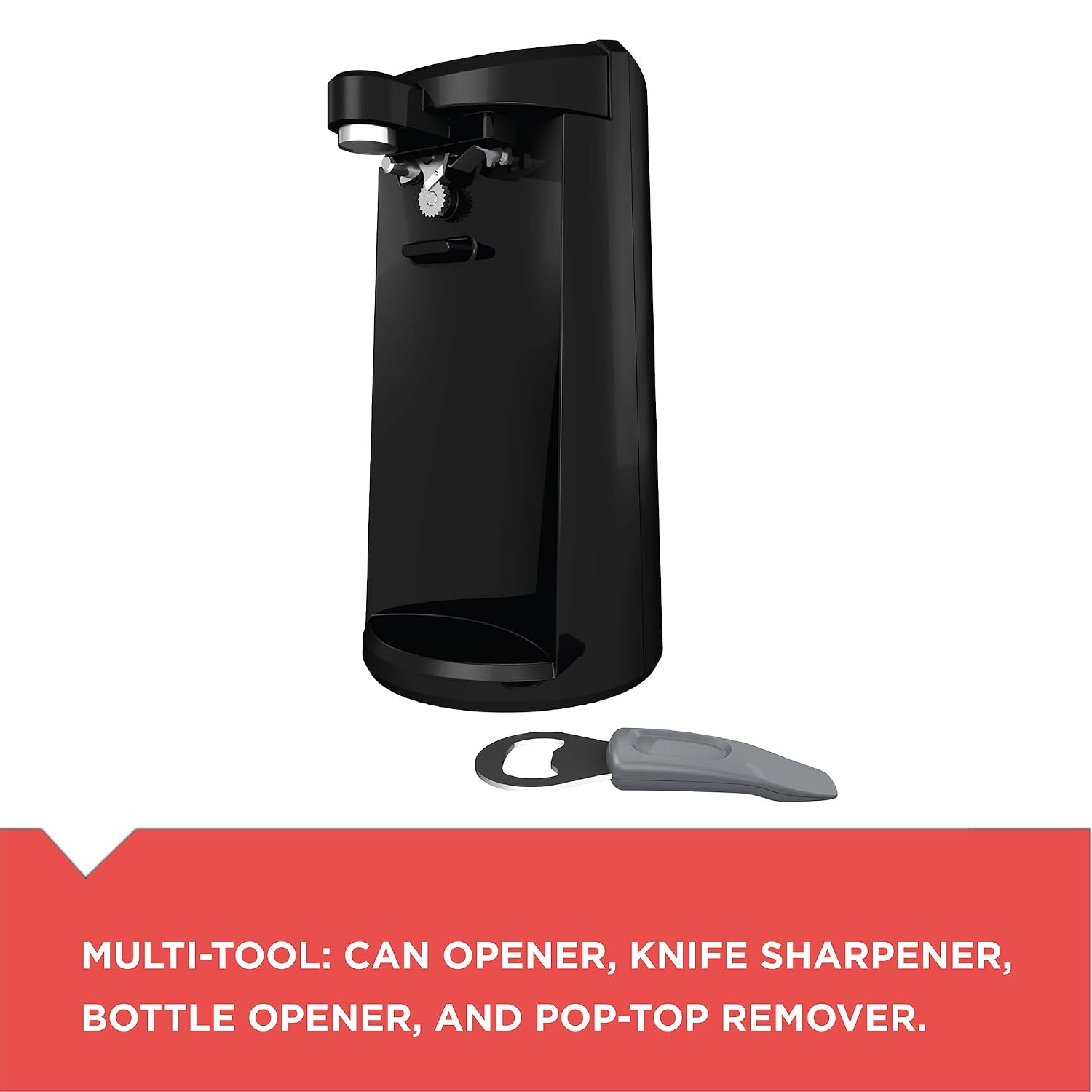
It cuts some cans and not others. What am I doing wrong?
This is the loudest complaint about it, and it is most likely seating rather than a dead machine. The blade has to bite the rim at the right depth, so the can must sit square against the base with its lip fully engaged before the cutter comes down, and the removable cutting assembly has to be fully home. Expect a short learning curve: some adjustment at first, and a couple of attempts to understand how it works. Cans with dented rims or unusual shapes are the ones most likely to defeat it, and no opener of any type handles those gracefully.
Is it genuinely easier if my hands hurt?
This is where it earns its place on a counter. Arthritis, a weak grip or a healing wrist all make a manual opener miserable, because that design asks for squeeze and twist at the same moment. Here the can spins in place on a stable base while the cutter does the work, and the one-touch lever releases the can afterwards, so you are not prising a heavy tin loose with sore fingers. For someone who bought it for exactly that reason, such as an 88-year-old who found handheld openers painful, it can make the job easy again.
Will it handle very tall cans, and very small ones?
Tall is the entire premise of this model. BLACK+DECKER built extra height and a wide stabilising base into it so that it works with most can sizes, and it manages genuinely large cans, such as big tins of pozole corn, without drama. That wide base is also what stops a heavy, full can from wandering mid-cut. Small cans are the less obvious risk: short, light tins can sit awkwardly under a mechanism designed around tall ones, so seat them deliberately before you start.
Will it fit under my kitchen cabinets?
Measure first, because extra tall cuts both ways. The unit stands 11 inches high and 9 wide, which clears the gap under most wall cabinets but can be tight where a shelf, spice rack or under-cabinet light eats the clearance. You also need headroom above the opener to load a can, not merely to store the thing. And the base wants to sit flat and fully supported, so a shallow counter run with the front edge overhanging is a bad home for it.
How do I clean it, and can any of it go in the dishwasher?
Hand wash only, as BLACK+DECKER instructs. The cutting assembly lifts out for cleaning, and the body, which houses the motor, should never go near water. That removable assembly is simultaneously the best and worst thing here: it makes rinsing away tomato paste and soup residue easy, and it is also the piece that most needs reseating carefully, since a head that is not fully home can make the opener appear to have stopped cutting. Push it fully back into place, dry it completely, and keep dried food off the stainless blade.
What tends to go wrong after a year or two?
Build quality is uneven, so buy with clear eyes. The body is plastic around a motor, and it can feel a little cheap for that reason. On any electric opener, the parts that age are the ones doing the work: the cutting wheel and the drive that turns the can. The warning signs are a cut that stops short of a full circle, or a motor that labours on a rim it used to handle. Cleaning the blade after sticky contents is the cheapest way to delay all of it. One thing worth knowing on day one: the pop-top and bottle-cap multi-tool stores in the back of the unit, not loose in the box.